What If Women's Work Counted?

I am writing this from a farm stay in Iowa, sitting at a kitchen table that belongs to someone I do not know, watching my mother and my daughter move through a morning together. I keep thinking about the invisible work of women on farms, the labor that has always kept these places running and almost never made it into the accounting. Three generations. My daughter is thirteen and already asking what will count on her college application. I am somewhere in the middle, professionally devoted to the question of how we know if anything works.
The irony is not lost on me.
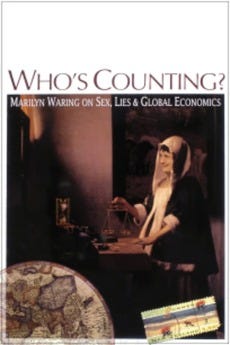
Marilyn Waring named the problem in 1988. In If Women Counted, she laid out the argument clearly: GDP was not a neutral accounting tool. It was a political choice about what matters. And that choice rendered invisible most of the work that keeps human life running: caregiving, subsistence farming, raising children, tending the sick, holding communities together. Work done overwhelmingly by women. Work that, by the official measure of national economic health, did not exist.
Waring was a New Zealand parliamentarian who had the audacity to read the UN System of National Accounts cover to cover and ask what it was actually counting. The answer: market transactions. If money changed hands, it counted. If it didn’t, it didn’t. A woman who cooks three meals a day for her family contributes nothing to GDP. If she has a breakdown and the family hires a cook, GDP goes up. This is not a bug. It is the architecture.
The accounting has not fundamentally changed since 1988. We have added satellite accounts and time-use surveys that gesture toward unpaid work. But the core logic holds: what gets measured gets valued, and what gets valued shapes what gets resourced, protected, and seen.
Some governments have tried to ask a different prior question. Bhutan’s Gross National Happiness framework, proposed in the 1970s, was not a rejection of economic development but a challenge to its premise: development toward what? GNH includes nine domains: living standards, yes, but also psychological wellbeing, time use, community vitality, cultural resilience, ecological health. Time use. That is where women’s labor begins to appear. GNH is imperfect and has been used politically in ways its originators did not intend. But the conceptual move matters: what a society measures reflects what it believes a good life looks like. And a good life, it turns out, requires a lot of things GDP cannot see.
I have been sitting lately with a related concept: mattering. Not achievement. Not productivity. Not impact in the social sector sense of the word. Mattering is simpler and harder than any of those. It is the experience of being noticed, being needed, having your absence register. It is the felt sense that you count, to someone, to something, to the fabric of a community. Research on community well-being suggests that mattering is not just emotionally significant. It is structurally significant. Communities where people feel they matter show up differently on almost every indicator we care about: health, resilience, civic participation, the ability to recover from disruption.
And yet mattering is almost never what we measure. We measure outputs. We measure reach. We measure satisfaction scores and pre-post surveys. We do not measure whether the grandmother in the corner of the room feels that anyone would notice if she stopped coming. We do not measure whether the volunteer coordinator’s judgment is trusted or just her hours. We do not ask who is holding the relational infrastructure and whether they know that we know.
This is an evaluation problem. It is also a Women’s History Month problem, an International Women’s Day problem, a looking-at-my-mother-and-my-daughter-across-a-farm-table problem. The work women have always done, the relational labor, the care work, the community maintenance, is precisely what our measurement systems were built not to see. Not because it is invisible. Because counting it would require admitting it matters. And admitting it matters would change what we owe.
If we measured mattering, we would have to resource it. If we counted care, we would have to compensate it. If GNH replaced GDP as our north star, we would have to confront that the economy we have built is not optimizing for human flourishing. It is optimizing for transactions. Waring knew this in 1988. Women doing unpaid work knew it long before she wrote it down.
What would it look like to measure what actually matters? Not a complete overhaul of every evaluation framework. Something more practical: adding questions about relational contribution to program assessments. Asking who holds the informal knowledge in an organization and whether that knowledge is protected. Designing time-use components into community needs assessments. Treating mattering as a measurable condition of community health, not a soft feeling that sits outside the data. We have the tools. We mostly lack the will to use them, because using them changes the answer to the question of whose work counts.
My mother spent decades cleaning other people’s houses. That work moves through the economy, but through what economists call the shadow economy, the informal sector where transactions are real and labor is hard and protections are scarce. No benefits. No unemployment insurance. No social security credits that reflect what she actually earned. The money changed hands, but the system was designed not to see her. And then there was raising three children, much of it on her own. That part didn’t register anywhere at all. My daughter is watching both of us, learning what counts. I want her to inherit better accounting than we did. Not just more indicators, but a different prior question. What is this for? Who does this serve? Whose work do we see?
The farm outside the window does not care about GDP. The morning does not care about outputs. And the three women at this table have always known that the most important things are the hardest to count.
That is not a reason to stop trying.

Anthralytic is a strategy and evaluation studio helping mission-driven teams clarify and amplify their impact. If you make decisions about resources in the social sector — whether you call yourself an evaluator or not — this newsletter is for you.